Epic Games has confirmed that Unreal Engine 5.9 is happening, and that a Preview build is due next week. The announcement came on 3 November 2026 in a post from the official Unreal Engine account on X, published during Unreal Fest Tokyo. The headline for many teams is a single line in that post: web is coming back as a target platform.
This Dev Log sets out what Epic has actually said, how 5.9 fits the road to Unreal Engine 6, and what we will check first when the Preview lands. We keep it to confirmed facts; where Epic has not published details yet, we say so.
What Epic confirmed
The X post lists four areas for 5.9:
- Improved AI workflows
- Web as a target platform
- Rendering and animation updates
- "plus more", with changes landing in the 5.9 branch on GitHub over the coming days
That is the full scope of the official statement so far. Epic has not yet published release notes, a feature list or documentation for the 5.9 web target. Questions such as which graphics API the web build uses, which renderer features it supports, or how large a packaged build will be remain open until the Preview and its notes are public.
Why 5.9 was not a given
At State of Unreal 2026 in June, Epic released Unreal Engine 5.8 and described it as the last planned major release for Unreal Engine 5. In the same breath it kept a door open: Epic said it was "reserving the option to release a 5.9, if needed", while continuing to support UE5 with bug fixes and regressions.
The 3 November announcement is Epic using that option. The reason it matters is the calendar. Epic is targeting an Early Access release of Unreal Engine 6 at the end of 2027, with a full release expected 12 to 18 months after that, according to its State of Unreal roundup and coverage such as This Week in Video Games. For teams shipping on UE5 in 2027 and beyond, a further UE5 release means new capability without waiting for a new engine generation.
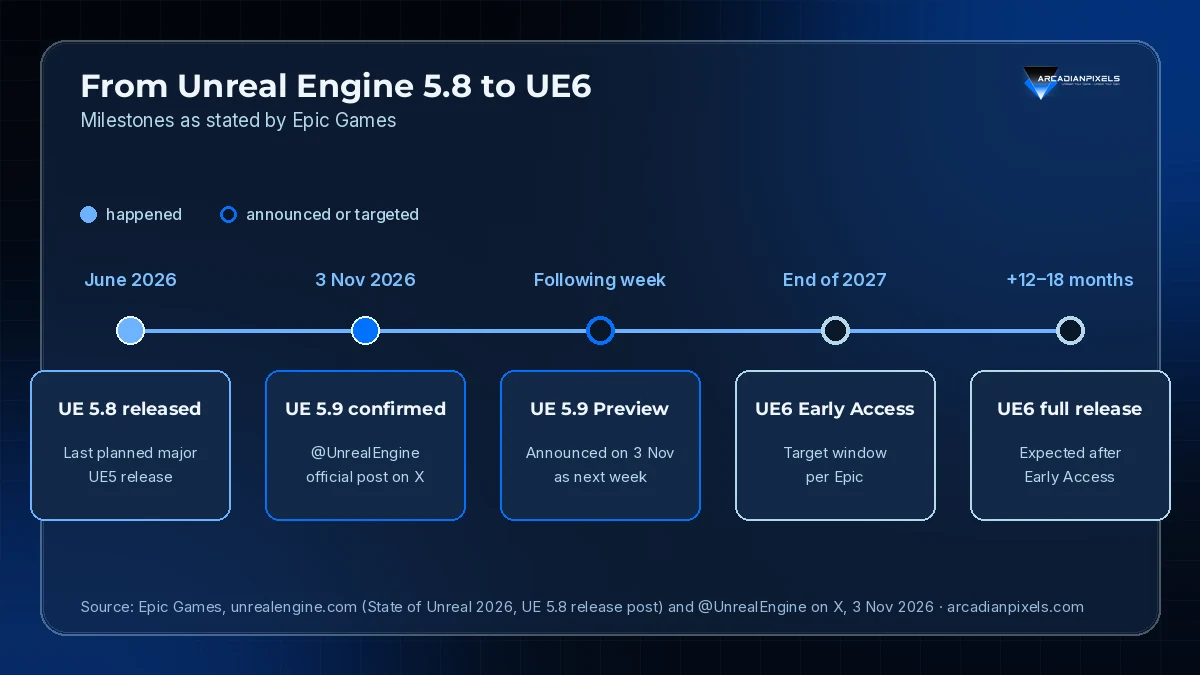
Source: Epic Games (unrealengine.com, State of Unreal 2026; @UnrealEngine on X, 3 Nov 2026) · arcadianpixels.com
The return of web
Web support in Unreal has a history. In the Unreal Engine 4 era, the engine could target HTML5 through Mozilla's Emscripten toolchain. According to Epic's UE 4.27 documentation, as of Unreal Engine 4.24 HTML5 support was moved out of the engine into a public Platform Extension maintained by the community on GitHub. Unreal Engine 5 has shipped without an official web target since its launch.
So "web as a target platform" in 5.9 is a return, not a first. What it will look like in 2026 is the open question, and we will not guess at it here. The useful thing is to know what to measure once the Preview is available.
What we will check in the Preview
- Packaging path. Whether web appears as a standard platform in project packaging, or requires a source build from the GitHub branch.
- Renderer scope. Which rendering features are available on web builds, and which are disabled or fall back.
- Build size and load time. How large a minimal packaged project is, and how long a cold load takes in a desktop browser.
- Input and audio. Gamepad, keyboard and audio behaviour across the main desktop browsers.
- Status label. Whether Epic marks the web target as Experimental, Beta or Production Ready in 5.9.
Each of these determines whether a web build is a playable demo, a marketing tool or a real shipping platform.
Why it matters for smaller teams
For studios like ours, a browser build is about reach and friction. A link that opens a playable slice removes the download, the store page and the install step. That is valuable for:
- Vertical slices and demos shared with playtesters, press and partners.
- Game jams and prototypes, where the fastest path to a player is a URL.
- Portfolio and community pages, where a short interactive scene says more than a trailer.
It is not a reason to change engines or plans on announcement day. Until the Preview is tested, nobody outside Epic can say how far a 5.9 web build will scale. Previews are also not meant for production projects: the sensible move is a separate test project, not an upgrade of a live one.
AI workflows: context from 5.8
Epic has not detailed the "improved AI workflows" in 5.9 yet. The context is 5.8, which introduced an Experimental Model Context Protocol (MCP) plugin that lets developers connect models such as Claude directly to Unreal projects, with an open interface so teams can choose their model. Epic has also said MCP-based integrations are part of its plan for UE6. It is reasonable to read 5.9 as the next step on that path, but the specifics are Epic's to publish.
Rendering and animation
The same applies to rendering and animation. In 5.8, Epic focused on performance and maturing core features: lighter dynamic global illumination in Lumen aimed at 60 fps on Nintendo Switch 2 and PCs, shader compilation and PSO pre-caching improvements, and several systems promoted to Production Ready. The 5.9 updates in these areas are confirmed in principle; their content is not public yet.
What we are doing
- Watching the 5.9 branch on GitHub and the Preview release notes when they appear.
- Testing in isolation. Any Preview build goes into a separate test project, never into a production project.
- Reporting back. Once the Preview is out and we have run the checks above, we will publish a follow-up here on the Dev Log with what we measured.
Sources
- Unreal Engine on X, 3 November 2026
- State of Unreal 2026: Top news from the show (Epic Games, 17 June 2026)
- Unreal Engine 5.8 is now available (Epic Games)
- HTML5 Game Development, UE 4.27 documentation (Epic Games)
- Epic confirms Unreal Engine 5.9 preview next week (RuntimeWire, 3 November 2026)
- Unreal Engine 6 to launch in Early Access at the end of 2027 (This Week in Video Games)