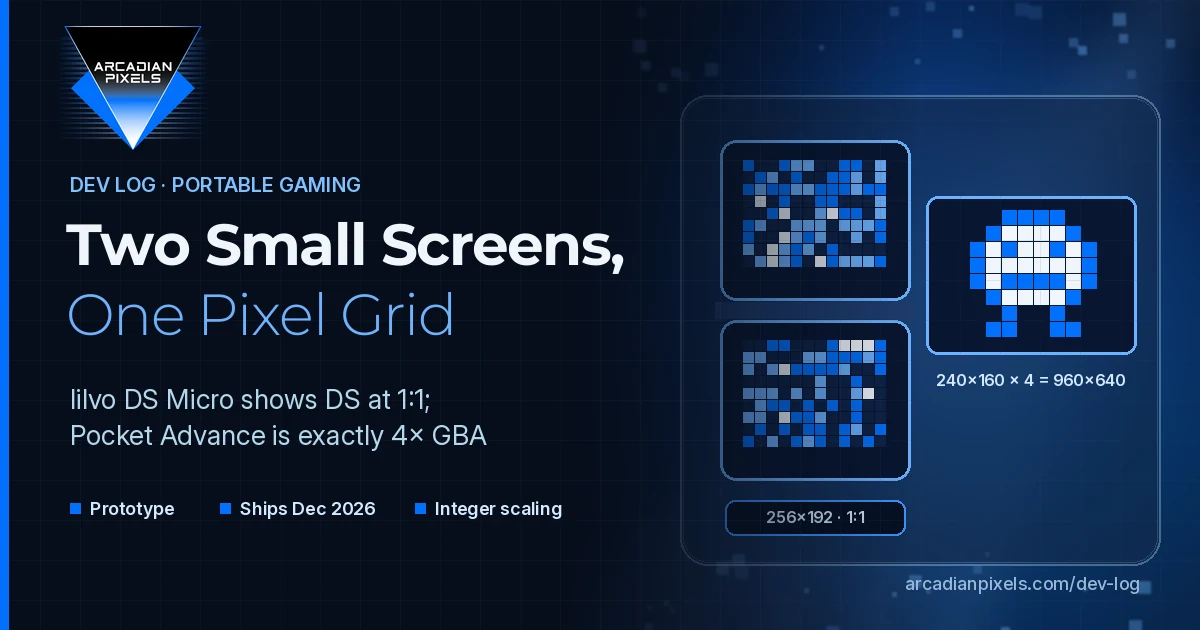
Two small handhelds made news this week, and they could hardly be more different. One is a dual-screen clamshell built by a single developer that is still a prototype. The other is a new variant of a mass-market Android device that ships in December. We are not reviewing either one, since we have not held them. What interests us is what their screens mean for anyone drawing sprites at native resolution.
lilvo DS Micro: a dual-screen prototype the size of a card
The lilvo DS Micro project log describes "a clamshell with two screens, real buttons and a real hinge, 85 × 46 × 18 mm closed". For scale, the page notes that a bank card is 85.6 × 54 mm. On 16 November the developer posted the first fully working prototype: new main board, white shell, and both screens, touch, L / R, the lid and sound all working. The project was then picked up by Retro Dodo and other outlets.
The current prototype specifications, which the page says "can still change":
- Processor: Allwinner T113, dual-core Cortex-A7 at 1.2 GHz
- Screens: 2 × IPS, 256 × 192 shown on each, capacitive touch on the bottom one
- Battery: 1200 mAh Li-Po
- Ports: USB-C for charging, files and updates; 3.5 mm jack; microSD inside the shell; no Wi-Fi
- Software: the lilvo system, a launcher written from scratch on mainline Linux
It runs DS through DraStic and eleven other systems through open-source libretro cores. The developer is clear about the limits: 2D DS games are the target for full speed, heavy 3D games skip frames, and most cores have not yet been tested on the real hardware. SNES and Mega Drive are left out because, as the FAQ explains, the best emulators for them have non-commercial licences. There is no price and no availability date: "I don't know yet, and I'd rather not guess."
What the build log teaches
The build log is worth reading even if you never build hardware. Two entries stand out:
- A battery sold as 1000 mAh held about 590 mAh in a full discharge test, and gave just under three hours of DS play at roughly 0.7 W. The readout was recalibrated in lilvo 1.6.
- Both RevD.8 boards came back dead. After a week of measuring and an X-ray, the cause was the main chip's centre pad not being soldered. The fix went into RevE.1.
Small teams shipping games face the same discipline: measure, write down the failure, then fix the process rather than the symptom.
KONKR Pocket Advance Ice Pink: same screen, more RAM
AYANEO listed the KONKR Pocket Advance x Ice Pink on its store, and Notebookcheck and Pocket Tactics report shipping in December 2026. The change is a translucent pink shell and a new top configuration with 6 GB of RAM and 64 GB of storage, up from 4 GB. Notebookcheck gives early prices of $89 for 3 GB / 32 GB and $119 for 6 GB / 64 GB.
The rest is unchanged from the models launched earlier this year: a 3.5-inch 3:2 LCD at 960 × 640, a MediaTek Helio G90T, a 4,000 mAh battery and Android 12. Time Extension, which tested the 3 GB unit, did not notice a large performance difference compared with the 4 GB unit it reviewed in August.
The pixel grid: why these two screens are interesting
For pixel art, the most important number on a handheld is often not the size of the screen but how its resolution relates to the resolution of the game. When the ratio is a whole number, every source pixel becomes an identical square block. When it is not, the image is either filtered and soft, or nearest-neighbour scaled with uneven pixel widths.
Both devices land on whole numbers for their most obvious use case:
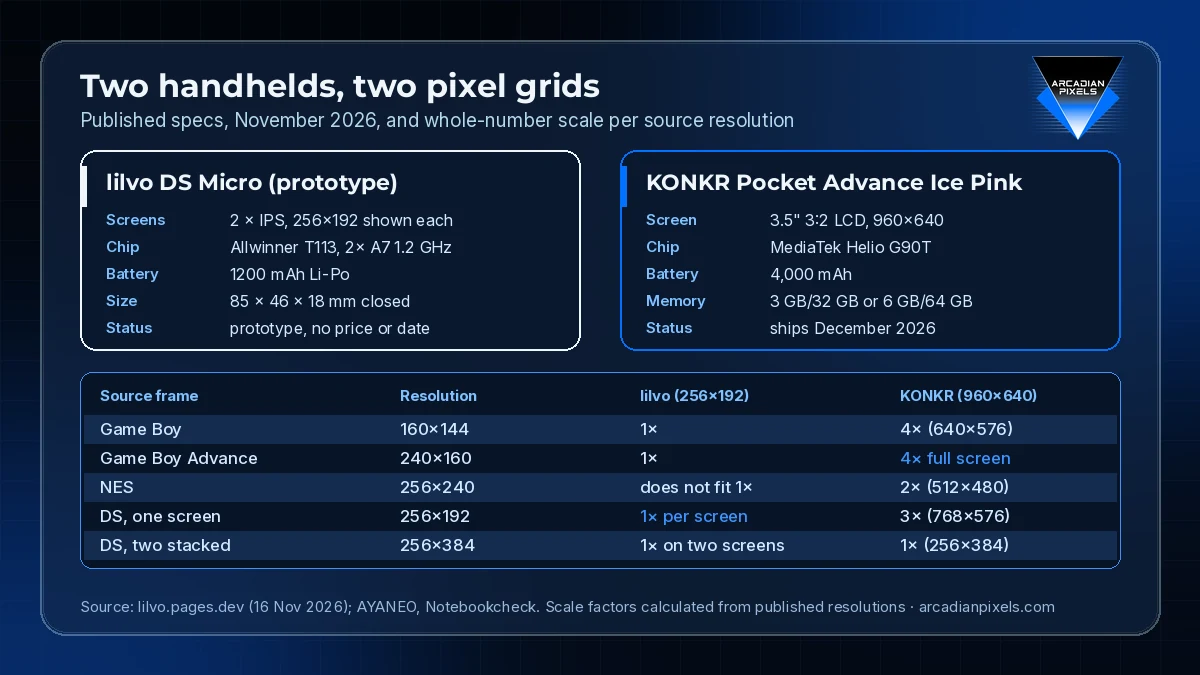
- lilvo DS Micro shows 256 × 192 on each screen, which is the native resolution of a DS screen. DS software appears at 1:1, with no scaling at all.
- KONKR Pocket Advance has a 960 × 640 panel. A Game Boy Advance frame is 240 × 160. That is exactly 4× on both axes, filling the screen with no borders and no filtering.
Source: lilvo.pages.dev (prototype specs, 16 Nov 2026); AYANEO, Notebookcheck. Scale factors calculated by Arcadian Pixels from the published resolutions.
The arithmetic also shows where each device gives something up. On the KONKR, two DS screens stacked need 256 × 384 pixels, which fits only at 1× on a 640-pixel-tall panel, so DS games are either small or scaled by a non-integer factor; a single DS screen on its own fits at 3×. On lilvo, an NES frame of 256 × 240 is taller than the 192-line screen, so it cannot be shown 1:1 without cropping or downscaling.
Notes for our own work
What we take from this for Arcadian Pixels Studio:
- Pick the base resolution with real screens in mind. 240 × 160 and 256 × 192 are not only nostalgic numbers; they still map cleanly to hardware that people buy today.
- Check the integer fit before the art is locked. A quick table of target screens and scale factors avoids late surprises with borders or soft edges.
- Treat small screens as a legibility test. A 2-inch screen at 256 × 192 forces UI text and sprite silhouettes to read at native size, with nothing to hide behind.
- Keep prototypes and products apart. lilvo is a promising project log, not a product you can order. We will follow the build log rather than speculate on a release.
Sources
- lilvo DS Micro project page and build log, lilvo, updated 16 November 2026
- The Lilvo DS Micro Is A Fully Working Miniature Nintendo DS With Its Own OS, Retro Dodo, 18 November 2026
- KONKR Pocket ADVANCE x ICE Pink, AYANEO store
- Ayaneo releases Konkr Pocket Advance with more RAM, Notebookcheck
- The new Ayaneo Konkr Pocket Advance is pretty in pink and RAM-boosted, Pocket Tactics
- AYANEO KONKR Pocket Advance Ice Pink Special Edition hands-on, Time Extension