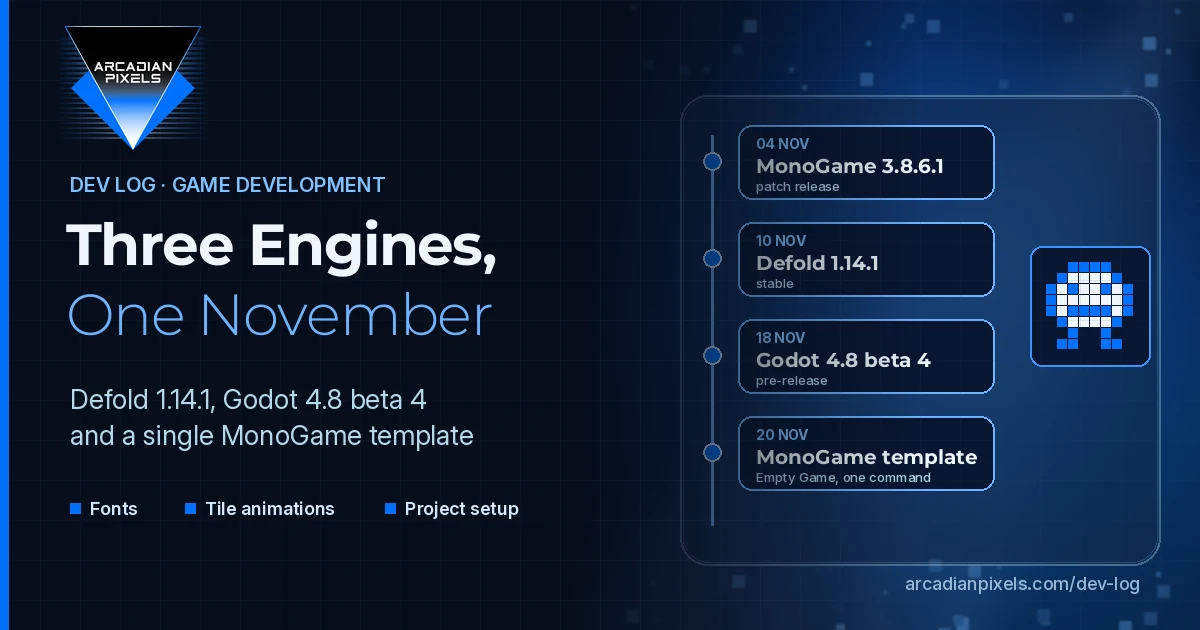
Three open-source engines shipped something in November that is worth a look for small 2D teams. Defold 1.14.1 is a stable release with changes to fonts, tile animations and web rendering. Godot 4.8 beta 4 is a regression-fix snapshot that may be the last beta before 4.8 stable. MonoGame, after its 3.8.6.1 patch, introduced a single "Empty Game" template that replaces the per-platform project choice. None of these is a headline feature for pixel art on its own, but each touches parts of the pipeline we use every week: text, tiles, builds and project setup.
Defold 1.14.1: fonts, tile animations and web pixel ratio
The Defold 1.14.1 release was published by the Defold Foundation on 10 November 2026. It is the largest of the three updates, and several items are directly relevant to sprite-based games.
Text rendering modes
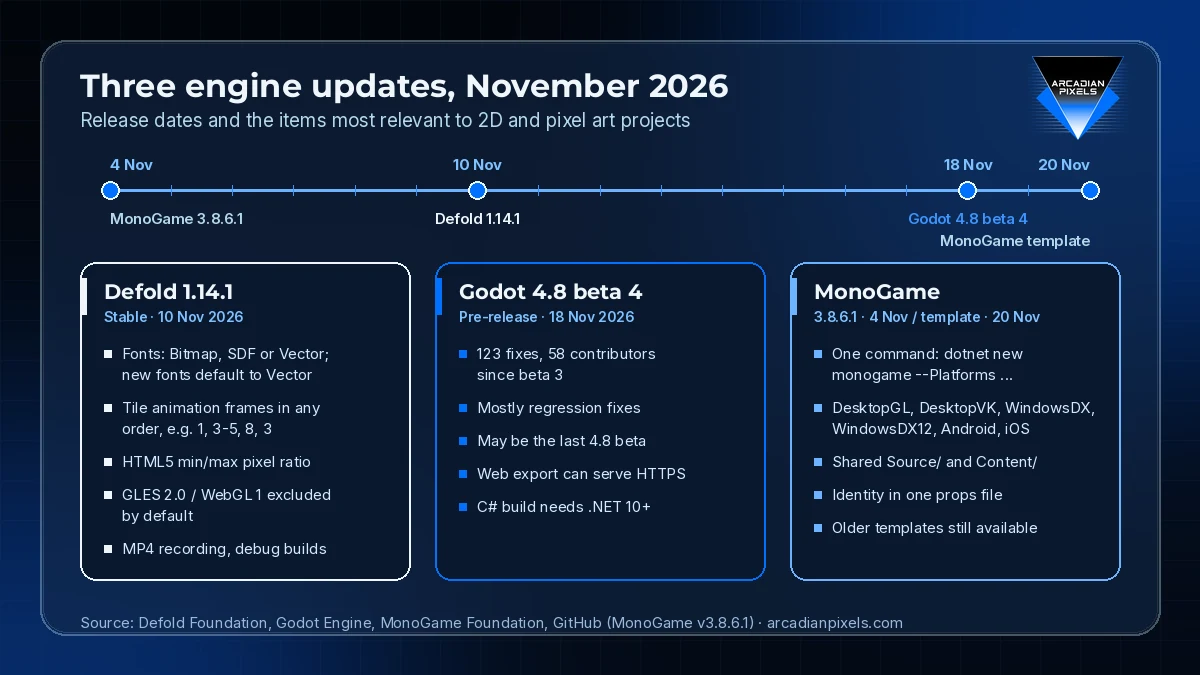
Font resources can now be set to Bitmap, SDF or Vector rendering, with glyphs generated either at build time or dynamically at runtime. Vector fonts use the Slug rendering approach, while outlines and shadows still use SDF. Existing SDF fonts keep working, but newly created fonts default to Vector mode.
For pixel art projects this default matters. A pixel font drawn for a fixed grid is usually meant to be shown at whole-number sizes, and the release notes list Bitmap as one of the three modes. We would set the mode explicitly on every new font resource rather than rely on the default, and check how each mode renders at the target resolution.
Tile source animations in any order
Tile source animations no longer need a contiguous start and end tile. Frames can be listed individually, as ranges, repeated and in any order; the release notes give 1, 3-5, 8, 3 as an example. In practice this means an animation can reuse a frame, such as a blink or an idle pose, without duplicating it in the sprite sheet.
Web, legacy shaders and recording
- HTML5 pixel ratio limits: with High DPI enabled, projects can set minimum and maximum pixel ratios, capping render resolution on dense displays without changing the canvas size.
- GLES 2.0 and WebGL 1 excluded by default: legacy shader targets are now off unless the Exclude GLES 2.0 setting in
game.projectis changed. Vector fonts do not work on those targets, and the notes state there is no automatic SDF fallback. - MP4 recording: desktop debug engines can record H.264 video through a new
recordermodule, replacing the earlier VP8/IVF format. Linux recording is video-only. - Native Lua debugging through the Debug Adapter Protocol, with breakpoints, stepping and variable inspection.
The release also reports performance work on particles and game object transforms, measured on the Foundation's own benchmarks. Those figures describe specific test scenes, and the notes themselves say that real frame-time gains depend on the project.
Godot 4.8 beta 4: closing the beta phase
Godot 4.8 beta 4 was published on 18 November 2026, about nine days after beta 3. The announcement states that most remaining release blockers have been resolved and that this may be one of the last beta snapshots of the 4.8 cycle, "potentially even the last". 58 contributors submitted 123 fixes since beta 3, and the build comes from commit b070e63b1.
The changes are mostly regression fixes. A few that could affect a 2D project:
- Import: invalid dynamic font imports are now validated and fail, instead of passing silently.
- Core: the text format version is updated for saved scenes with metadata or embedded scenes.
- Audio: playbacks start paused when the player node cannot process.
- Web: the export can now "serve" over HTTPS, useful for testing web builds locally.
- Editor: the inspector is cleared when its object is invalidated.
One requirement changes for C# users: the .NET build now needs .NET 10 or newer, raising the minimum from .NET 8. We covered the main 4.8 features when beta 1 shipped in October; beta 4 adds no new features, which is the expected shape of a late beta.
What this means in practice
With a release candidate likely to follow, this is the point to open a copy of an existing project in beta 4 and report regressions, not to move production work. The scene format version change is one more reason to test on a branch, and the announcement itself recommends frequent backups or version control for pre-release builds.
MonoGame: one template for every platform
On 20 November 2026 the MonoGame Foundation announced a new "Empty Game" template. A new project is now created with one command, choosing platforms as options:
dotnet new monogame -n MyGame --Platforms gl vk dx12
The template ships in the MonoGame C# template pack from version 3.8.6.1. That patch release was published on GitHub on 4 November 2026 and also includes fixes for the Vulkan, DirectX 12 and DesktopGL backends. The older templates remain available.
According to the template repository, shared code lives once in Source/, assets go through the new Content Builder project in Content/, and each folder under Platforms/ holds only an entry point and configuration. The listed targets are DesktopGL, DesktopVK, WindowsDX, WindowsDX12, Android and iOS. Game identity, such as the executable name, application ID and version, is set in a single Resources/Identity.props file.
For a small team this removes a common source of drift: separate platform projects that slowly diverge. The foundation also published a new Getting Started guide that ends with a small Pong game.
The three releases side by side
Source: Defold Foundation (10 Nov 2026), Godot Engine (18 Nov 2026), MonoGame Foundation blog (20 Nov 2026) and GitHub release v3.8.6.1 (4 Nov 2026).
Notes for our own work
What we take from these updates for Arcadian Pixels Studio:
- Set font modes explicitly. When a tool changes a default, as Defold did with Vector fonts, pixel fonts should be pinned to the mode they were drawn for and checked at native size.
- Keep sprite sheets lean. Arbitrary frame order, as in Defold's tile source animations, lets repeated poses stay as a single frame in the sheet.
- Test betas on a branch. Godot 4.8 beta 4 is the right build for regression reports; production stays on the current stable release until 4.8 is final.
- Check legacy web targets. If a project still targets WebGL 1 or GLES 2.0 devices, Defold's new default needs a deliberate setting.
- One project, many targets. MonoGame's template follows the same idea we apply elsewhere: shared code and assets in one place, platform folders kept thin.
Sources
- Defold release 1.14.1, Defold Foundation, 10 November 2026
- Dev snapshot: Godot 4.8 beta 4, Godot Engine, 18 November 2026
- New "Empty Game" MonoGame template, MonoGame Foundation, 20 November 2026
- MonoGame v3.8.6.1 release notes, GitHub, 4 November 2026
- MonoGame.EmptyGame.CSharp, template repository README