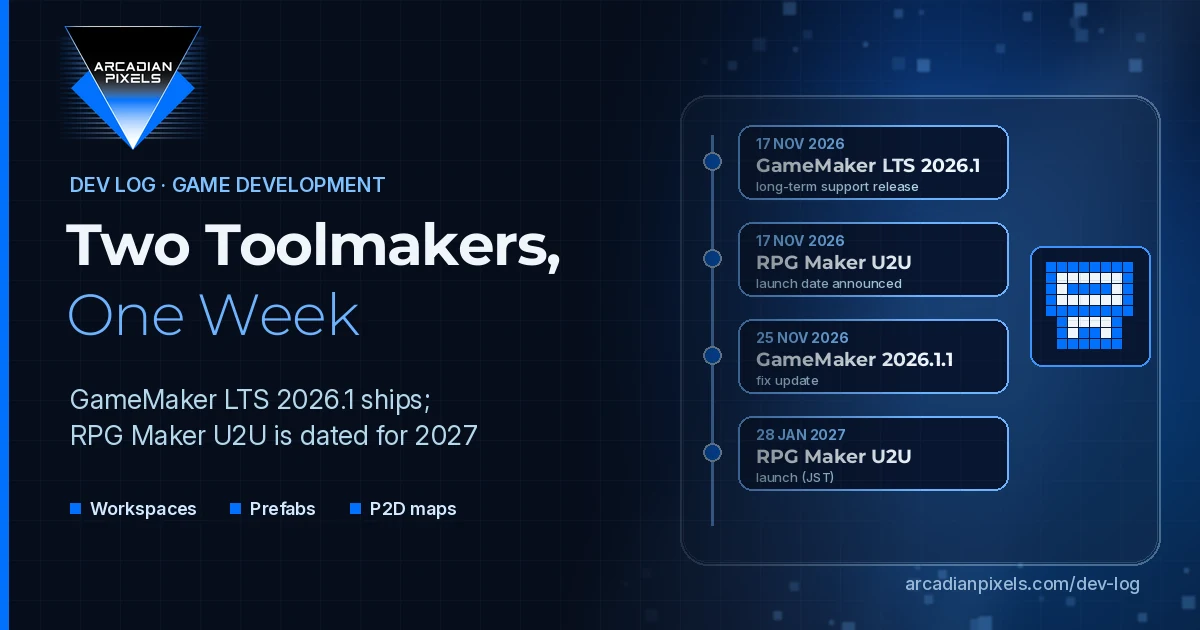
Two long-running 2D toolmakers moved in the same week. On 17 November 2026 GameMaker shipped LTS 2026.1, its new long-term-support release, and followed it with a 2026.1.1 fix update on 25 November. On the same 17 November, Gotcha Gotcha Games dated RPG Maker U2U for January 2027 and extended its free P2D map editor demo until launch. One is a stability release for teams already shipping, the other a new tool that changes how top-down maps are built. Both deserve a careful read before anything is migrated.
GameMaker LTS 2026.1: stability first
The LTS 2026.1 release notes describe a release that "focuses a lot on stability and updating SDK support". The original 2026.1.0 build (IDE 27, runtime 28) is dated 17 November 2026. The 2026.1.1 update, now listed as the current version (IDE 34, runtime 30), appeared on Steam on 25 November according to SteamDB and fixes the most-reported issues from the first build.
New features worth knowing
- Split workspaces: a workspace can be split vertically or horizontally, so two editors, including Code Editor 2 windows, can sit side by side. Only one split direction is allowed at a time, but several splits in that direction are possible.
- Prefab Builder: teams can now build their own prefabs, keep them private or share them. The Prefab Library adds version ranges for dependencies, one-click dependency upgrades and a button to view included license files.
- Room Editor selection priority: a new preference decides whether clicking an unselected, overlapping item keeps the current selection or replaces it. This matters on busy layers where sprites overlap.
- GMRT in the install dialog: the IDE can remember which GMRT targets to install with each update; they download in the background after the Start Page loads.
- Restart dialog: when the IDE restarts itself after a GPU driver problem, it now explains what happened.
Changes that can break a build
The notes are explicit that some projects will need attention before they build again:
- SDK updates for Android (SDK 37 and newer are now detected), Xcode 27 on all Apple targets, and new SDKs for PS5, Switch and Switch 2. Preferences now highlight values that do not match what the active runtime expects.
- Rollback functionality removed. This beta-only multiplayer feature is gone. The notes advise projects that rely on rollback to stay on 2026.0 until they have an alternative.
- Tile collisions:
collision_rectanglefunctions now report hits on tiles with the same rules used for instances, and the notes warn that code may need refactoring.
For pixel art projects, a few smaller fixes are relevant: sprites smaller than 32x32 now show a preview in the Asset Browser, a crash when dragging a sprite into the Tilesets group was fixed, and multi-sub-image sprites no longer break manual ellipse and diamond collision masks.
Licensing context
LTS 2026.1 arrives a month after GameMaker announced on 23 October that its next-generation runtime, GMRT, will be free for commercial use on desktop, mobile, web and GX Games from 1 January 2027, with source access on every tier. Console export still requires an Enterprise license and approved developer status, and tier pricing is unchanged.
RPG Maker U2U: a date and a longer demo
Gotcha Gotcha Games announced on 17 November 2026 that RPG Maker U2U launches on 28 January 2027 (JST). The Steam page currently lists 27 January 2027; the official date is given in Japan time. The KADOKAWA press release adds that the P2D Map Editor demo, live on Steam since 20 October and originally due to close on 16 November, now stays available until launch day.
What P2D is
P2D stands for Perspective 2D. According to the Steam page, it combines top-down mapping with real elevation: slopes, ledges, multi-storey buildings and overpasses. It adds camera effects such as depth of field, weather such as rain and fog, and lighting and shadows. Characters hidden behind walls or structures are drawn as silhouettes automatically. The store page lists more than 100 pre-built P2D maps and a dedicated editor that places prefab objects or builds new ones block by block.
Migration limits
The publisher is clear about what carries over:
- Assets: existing RPG Maker MV and MZ art can be reused as P2D map assets.
- Workflow: the interface is built around the RPG Maker MZ workflow.
- Projects and plug-ins: conversion of project data and plug-ins from previous RPG Maker titles is not supported.
- Demo maps: maps saved in the demo can be carried over to the full version, according to the press release.
The minimum requirements on Steam are a 64-bit Windows 11 system, a DirectX 11 compatible graphics card, 8 GB of RAM and 10 GB of storage.
The dates in one view
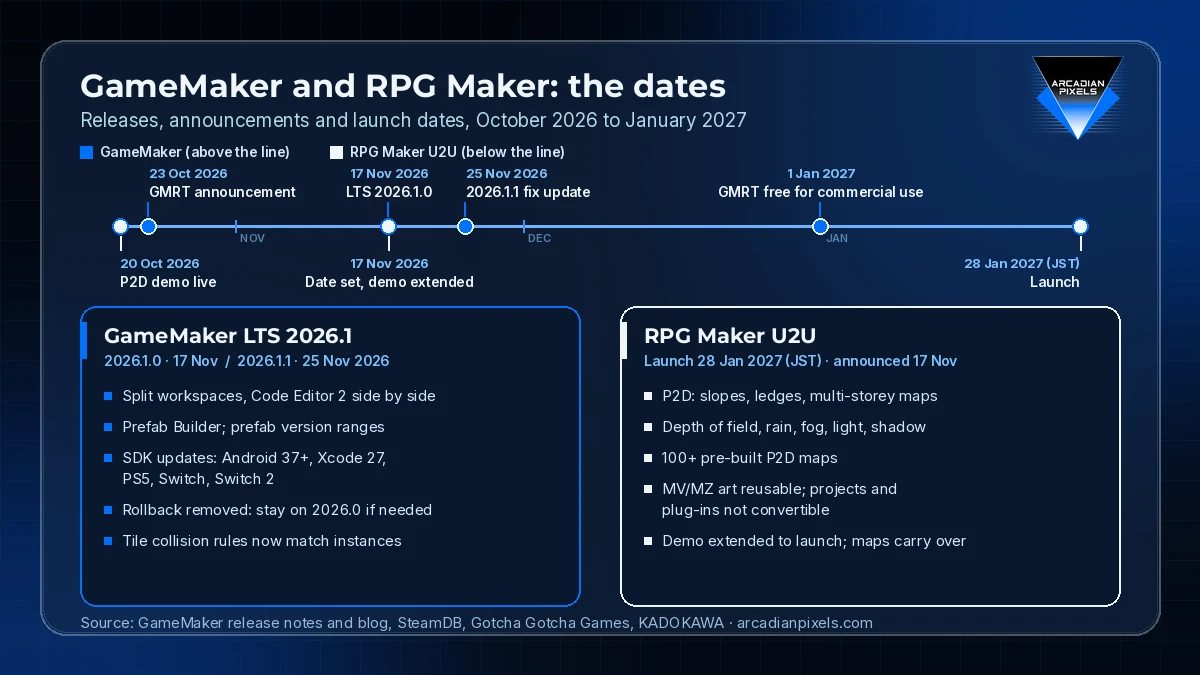
Source: GameMaker release notes and blog, SteamDB, Gotcha Gotcha Games and KADOKAWA press release (17 Nov 2026).
What this means for small 2D teams
For a team with a GameMaker project in production, LTS 2026.1 is the version to plan around, but not on the first day. The SDK changes alone mean the build machine needs updating, and the tile collision change can alter gameplay without a compile error. We would open a copy of the project on a branch, run the collision-heavy rooms and compare behaviour before switching. Projects that depend on rollback multiplayer should stay on 2026.0 for now, as the notes recommend.
For RPG Maker users, U2U is a new tool rather than an upgrade path. An MZ project in progress should be finished in MZ; the art can move later, the plug-ins and project data cannot. The extended demo is the practical way to judge whether P2D suits a given art style. It saves maps that carry over, so time spent on test maps is not lost.
Neither release changes the basics of pixel art production: fixed grids, whole-number scaling and clean tile sets. What they change is the tooling around them, and in both cases the release notes and store pages state the limits clearly. Reading them first is cheaper than finding those limits mid-project.