Two small releases from the past week caught our attention, and neither comes from a large engine vendor. Deki 0.30.3, published on 7 November 2026, adds experimental 3D, a shared lighting component and a build target for the Miyoo Mini handheld. Rigby2D 0.5, published on 6 November 2026, adds a native Defold runtime and marks its Godot runtime as production-ready.
One is an engine aimed at microcontroller boards and retro handhelds, the other a free 2D skeletal animation editor. Both touch the same work we do every week: getting pixel art and small 2D characters onto constrained screens without paying for overhead we do not need. This Dev Log sets out what each team has published, and what we intend to check before either tool goes anywhere near a production branch.
Deki 0.30.3: a small engine reaches a retro handheld
Deki describes itself on its homepage as a modular C++ engine with a visual editor that can drive an LCD from an ESP32 or run the same project on Windows through SDL3. Version 0.30.3 extends that to three areas.
3D on boards and desktop
The new deki-3d package draws meshes in the same frame as the 2D layer, with a single sort order, so a UI sits over a 3D scene the same way it sits over sprites. On a board it is a software rasteriser that draws in tiles. The depth buffer is therefore one tile: 2 KB at 32 pixels, against about 150 KB for a full 320 × 240 buffer, according to the release post. On the desktop the same package draws through OpenGL with shadows and shaders.
The Deki team published frame rates for several scenes. We have collected them in one table; they are the team's own figures, not our measurements.
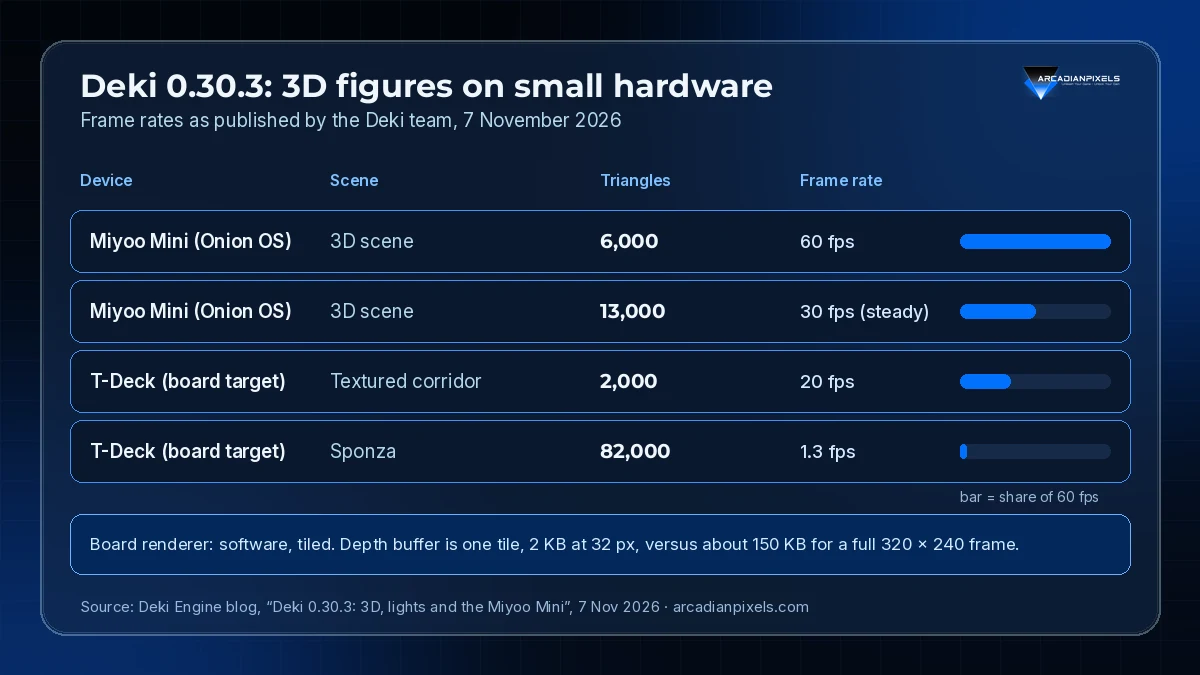
Source: Deki Engine blog, "Deki 0.30.3: 3D, lights and the Miyoo Mini", 7 Nov 2026 · arcadianpixels.com
The package is labelled experimental: its properties and file format may still change. Models are imported from .obj files, and each platform's build keeps a configurable share of the triangles. A board build stops if a model will not fit in the board's memory, which is the kind of hard failure we prefer to a silent fallback.
One light for 2D and 3D
A single Light component (Ambient, Directional, Point or Spot) lights both meshes and the 2D world. The detail that matters for pixel art is on the board side: 2D lighting there runs on the CPU, and a Bands setting of 2 to 8 produces hard, dithered rings instead of smooth gradients. On the desktop, 2D is lit per pixel on the GPU, with shadows from up to two directional or spot lights per frame. A game without a Light spends no memory on lighting.
Texture filtering is set per image and per platform (Point, Bilinear or Trilinear). A board without a GPU always draws Point, and the inspector says so. That is a useful guard against art that looks right on the desktop and wrong on the device.
The Miyoo Mini target
The new deki-miyoo-boards package builds a game for the Miyoo Mini and installs it to the SD card. The published details are specific:
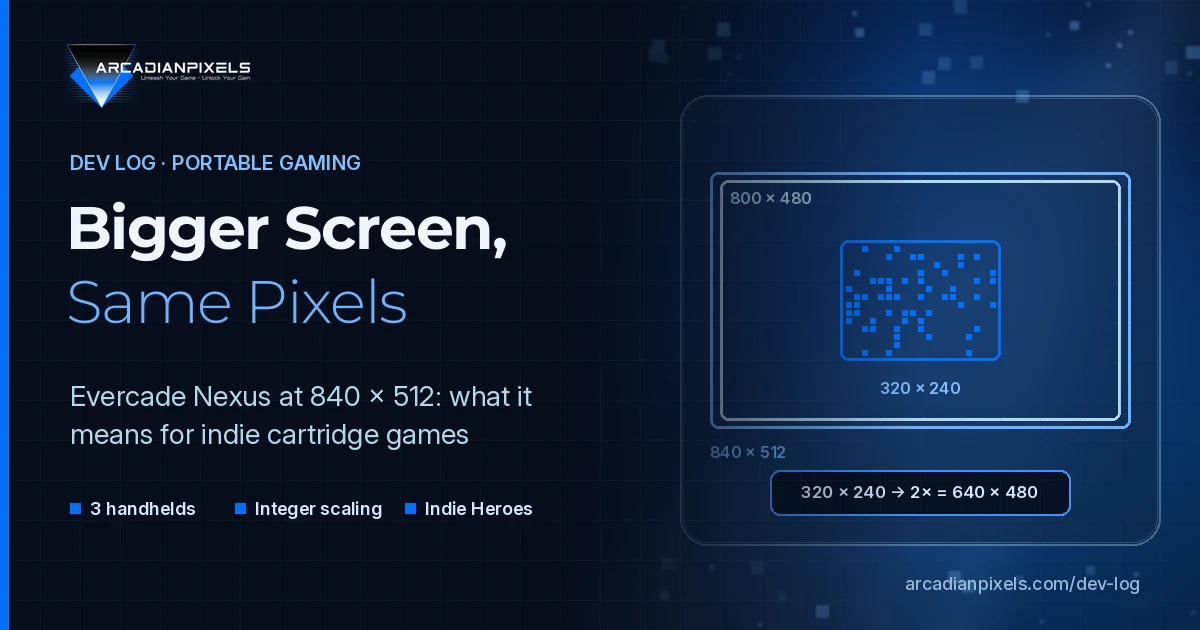
- Output is 320 × 240 in ARGB8888, scaled 2× to the panel.
- MENU quits the game.
- It was tested on Onion; stock firmware is not tested yet.
- Sound, battery and brightness are not in this version.
The missing audio is the limiting factor. A 320 × 240 base resolution with an exact 2× scale is a clean fit for pixel art, but a target without sound is a test bed, not a shipping platform. We read 0.30.3 as an invitation to prototype, and we will treat it that way.
Rigby2D 0.5: free 2D rigs for more engines
Rigby2D is a 2D skeletal animation editor whose stated position is that every feature and every runtime is free to ship and open source. The 0.5 release post frames the comparison directly against Spine. For reference, Esoteric Software's purchase page lists Spine Professional at $379 (down from $449) and Spine Essential at $69, with meshes and IK limited to Professional.
What 0.5 adds
- A native Defold runtime in C++, covering the platforms Defold ships to: Windows, macOS, Linux, Android, iOS and HTML5. It plays meshes, IK, physics, skins and scenes.
- Godot runtime out of preview:
RigbySkeleton2DandRigbyScene2Dare now marked production-ready. - GPU sprite sheet export to packed sheets with JSON for Phaser and PixiJS, a Defold atlas or plain PNG frames, with automatic splitting when a sheet is too large.
- SVG import from Inkscape and Affinity, layer by layer, and one-click mesh generation from an image.
- Phaser 4 support, custom shortcuts and copy and paste of timeline keys.
Rigby2D now lists seven runtimes: Unity, Godot, Defold, Cocos Creator, Phaser, JavaScript and Rust. It also states that it opens Spine exports (JSON and .skel, versions 3.8 to 4.3) and DragonBones projects, with an import check that reports what carries over before a switch.
Why sprite sheet export matters to us
Skeletal animation and pixel art do not always mix. Rotated and deformed sprites break the pixel grid unless the result is rendered back to frames at native resolution. An export path that bakes rigs to sprite sheets means a team can animate with bones and still ship hand-checkable frames. Whether the output stays crisp at 1× is something we will verify ourselves rather than assume.
What we will test
| Tool | Version | What we will check |
|---|---|---|
| Deki | 0.30.3 | Miyoo Mini build on Onion, 2× scaling of a 320 × 240 sprite scene, banded 2D lighting on the board path |
| Rigby2D | 0.5 | Godot runtime in a current Godot 4 project, sprite sheet export at native pixel resolution, Spine import report on an existing rig |
One note for the Godot side: the Godot 4.8 beta 3 snapshot of 9 November 2026 raises the minimum for the .NET build to .NET 10. Any runtime test we run on the 4.8 beta will record which build we used.
Neither release changes our main stack. Both are small, clearly documented, and honest about what is missing, which is what makes them worth an afternoon of testing. We will report back in a later Dev Log with our own results.