Blaze Entertainment's Evercade Nexus went on sale at the start of November at £169.99, $199.99 and €199.99, through Amazon, Funstock, Best Buy, GameStop and other Evercade retailers, as Funky Kit and Tomb Raider Chronicles reported on 1 and 2 November. It is the largest handheld in the Evercade line, and the first with dual analogue sticks.
Most coverage reads the Nexus as a player device for 32-bit and 64-bit collections, with Banjo-Kazooie and Banjo-Tooie in the box. For small teams making pixel art games, the more interesting part is the platform underneath: a physical cartridge format that also carries modern retro indie titles, and a new screen that every cartridge has to work on. This Dev Log looks at what Blaze published, what reviewers found, and what the numbers mean for anyone designing at low base resolutions.
What Blaze published
The figures below come from the official Evercade Nexus page, checked on 3 November 2026:
| Item | Evercade Nexus |
|---|---|
| Screen | 5.89-inch IPS, 840 × 512, 500+ nits |
| Processor | Quad core 1.5 GHz |
| Memory | 512 MB DDR |
| Battery | 5,000 mAh, "5+ hours" |
| Controls | Dual analogue sticks, D-pad, face buttons, rear bumpers and triggers |
| Connectivity | Wi-Fi 6 for console updates, wireless headphones, 3.5 mm jack |
| Size and weight | 215 × 111 × 34 mm, 410 g |
| Extras | TATE mode for vertical arcade games, turbo fire, RGB logo |
Blaze also states that every Evercade cartridge works across all Evercade devices, with a firmware update sometimes required, and that the library now counts more than 80 cartridges and 700 games.
The new feature is EverSync: two Nexus consoles connect directly for local multiplayer, without Wi-Fi or internet, and only the host needs the cartridge. It works only between two Nexus units.
What the first reviews say
The early reviews agree on the screen and disagree on little else. Tom's Guide measured close to four hours of battery with Banjo-Kazooie at default brightness, against Blaze's "5+ hours", and missed a suspend mode. GamesRadar+ also got about four hours and notes that the Nexus keeps the same base hardware as the 2020 original for backwards compatibility. VGC found boot and game load times slower than they should be, pointed out that there is no HDMI output, and could not yet test EverSync. Creative Bloq described EverSync as "a little patchy" in its hands-on session.
For developers the takeaway is plain: the Nexus is a better screen and better controls on a deliberately modest processor. It is not a new performance tier.
Three screens, one cartridge
Because a cartridge has to run on every Evercade device, the useful question is not "what does the Nexus show" but "what do all the handhelds show". Blaze's own FAQ lists the three current handheld panels: the Nexus at 840 × 512, the EXP and EXP-R at 800 × 480, and the Super Pocket at 320 × 240.
Pixel art looks best at whole-number scale factors, where every source pixel becomes the same square block. We worked out the largest integer scale for common base resolutions on each panel:
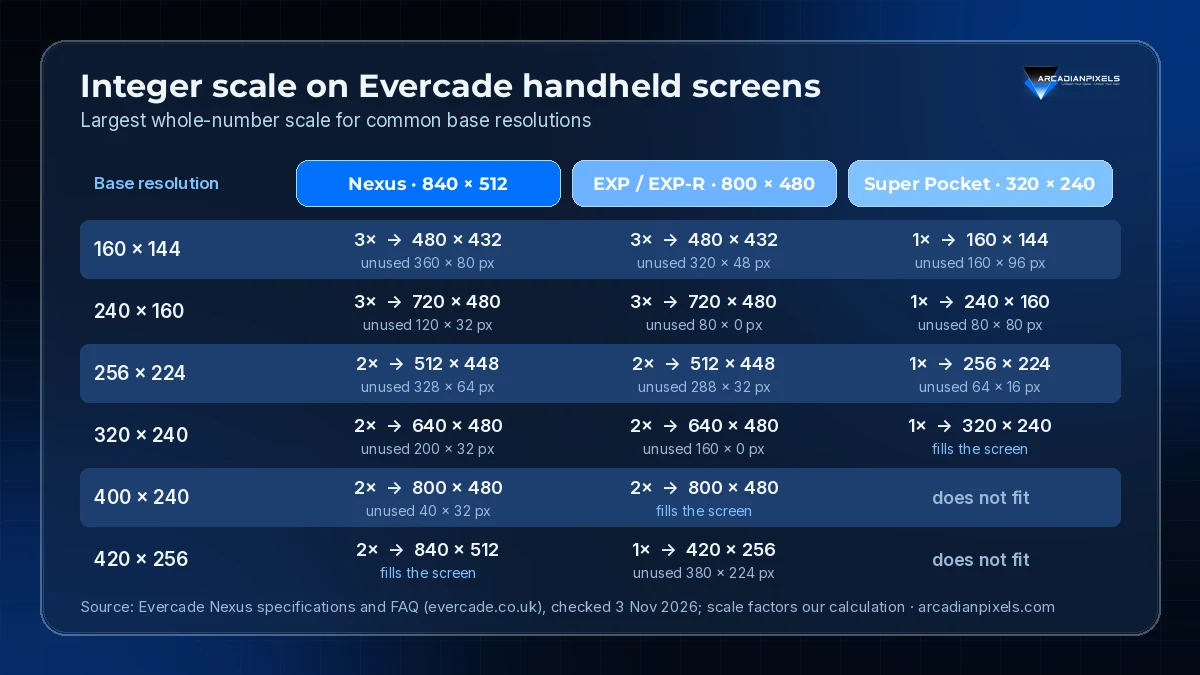
Source: Evercade Nexus specifications and FAQ (evercade.co.uk), checked 3 November 2026. Scale factors are our own calculation.
Two things stand out.
The Nexus adds border, not scale. For every classic base resolution in the table, the integer scale on the Nexus is the same as on the EXP. The extra 40 × 32 pixels give a slightly larger border around a 2× or 3× image. Only a game designed at exactly 420 × 256 would fill the Nexus at 2×, and that same game would drop to 1× on the EXP and would not fit the Super Pocket at all.
320 × 240 is the safe common target. It is native on the Super Pocket and an exact 2× (640 × 480) on both larger screens. A game at 400 × 240 fills the EXP perfectly but cannot be shown unscaled on the Super Pocket. How a native Evercade title actually handles output resolution on each device is defined by Blaze's tooling, which we have not seen, so treat this as layout arithmetic rather than a platform rule.
Where indie games fit
Evercade has a documented route for new indie work. The Indie Heroes cartridges collect modern retro games, and the fourth volume, announced in January 2025, carried 11 titles such as Flea!2, Murtop and Starseed. Blaze describes them as "games originally created for retro-inspired platforms", and notes that Evercade runs games both through emulation and natively.
The feeder for those cartridges is the Game of the Month programme. After a 2025 break, reported by Retro News, it returned in 2026 with BioMenace Remastered by Rigel Gameworks. Blaze's page says owners can download a new independently developed game each month between April and December, that the Nexus joins the programme "later in the year", and that the 2026 titles will be compiled into Indie Heroes Collection 5 early next year.
In practice, a game that fits classic hardware limits can reach players first as a monthly download and later on a numbered physical cartridge with a printed manual. For teams that want a physical release without manufacturing their own carts, that is one of the few established paths.
Notes for small pixel art teams
- Design for the smallest screen first. If a cartridge release is the goal, 320 × 240 or smaller keeps the game whole on the Super Pocket and gives clean 2× scaling on the EXP and Nexus.
- Budget for the existing hardware. GamesRadar+ reports that the Nexus keeps the base hardware of the 2020 original, so the new screen does not change what a cartridge game can draw per frame.
- Plan vertical layouts carefully. TATE mode returns on the Nexus. A vertical shooter has to scale across a 512-pixel axis on the Nexus and a 480-pixel axis on the EXP, so test the rotated layout on both.
- Do not build around EverSync yet. It needs two Nexus units, and early hands-on reports call it inconsistent. Creative Bloq still points players who want multiplayer to the Evercade VS home console.
- Keep the manual in mind. Every cartridge ships with a full-colour manual written by Blaze, so clear controls and a short, readable premise help the game on the shelf.
Our view
The Nexus does not change the rules of retro development. It shows that a dedicated, cartridge-first handheld can still be released and reviewed seriously in 2026, and that the publisher behind it keeps a regular slot for modern indie games. For Arcadian Pixels Studio, the screen arithmetic is the practical part: a 320 × 240 baseline still covers every current Evercade handheld cleanly, and the larger panel rewards that discipline rather than replacing it.