Gaming Nostalgia: What the NES Still Teaches Pixel Teams
This is the first entry in Gaming Nostalgia, a daily Arcadian Pixels column on old-school games — from arcade cabinets and the Nintendo Entertainment System through Super Nintendo, Sega Genesis, PlayStation and Nintendo 64. We are not writing fan retrospectives. We look at design and technical choices that still matter when you ship a 2D or pixel-art game in 2026.
We start where a large part of the craft was formalised for home consoles: the NES.
Why open with the NES
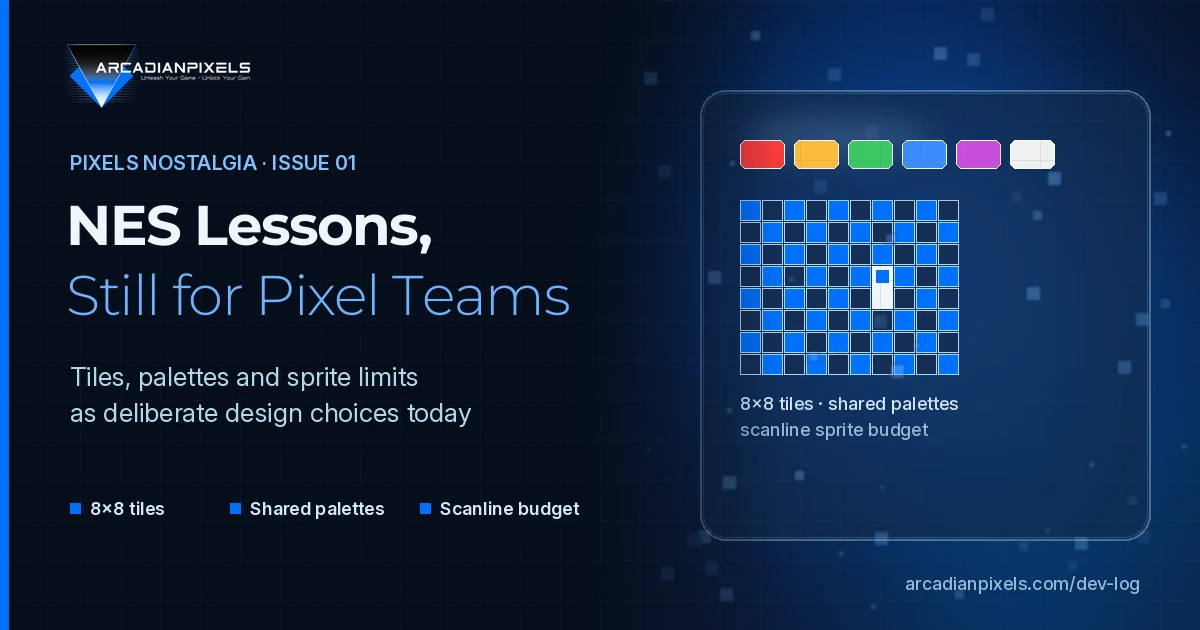
The NES (Famicom in Japan) did not invent pixels, but it fixed a set of rules that studios still feel when they pick a base resolution, a palette or a sprite budget. The Picture Processing Unit drew backgrounds from 8×8 tiles, limited how many colours a tile region could use, and capped how many sprites could appear on a single scanline. Those were hardware limits. Today they are design choices — and good ones, if you treat them as such.
For a studio that builds pixel games and tools, the NES is a useful laboratory: every constraint is documented, every workaround is visible on screen, and the results still read clearly forty years later.
Tiles before canvases
NES backgrounds were not freeform bitmaps. Screens were assembled from a nametable of tile indices and an attribute table that assigned palettes in 16×16 blocks. Artists learned to think in reusable parts: a cliff edge, a window, a ground strip that could repeat without looking broken.
That habit still pays off. A modern Godot or custom 2D pipeline that starts from a tile set — even when the engine could blit full frames — keeps art consistent, keeps memory predictable and makes level iteration faster. When a scene looks “muddy”, the NES question still helps: which tiles are unique for a reason, and which should have been variants of one master?
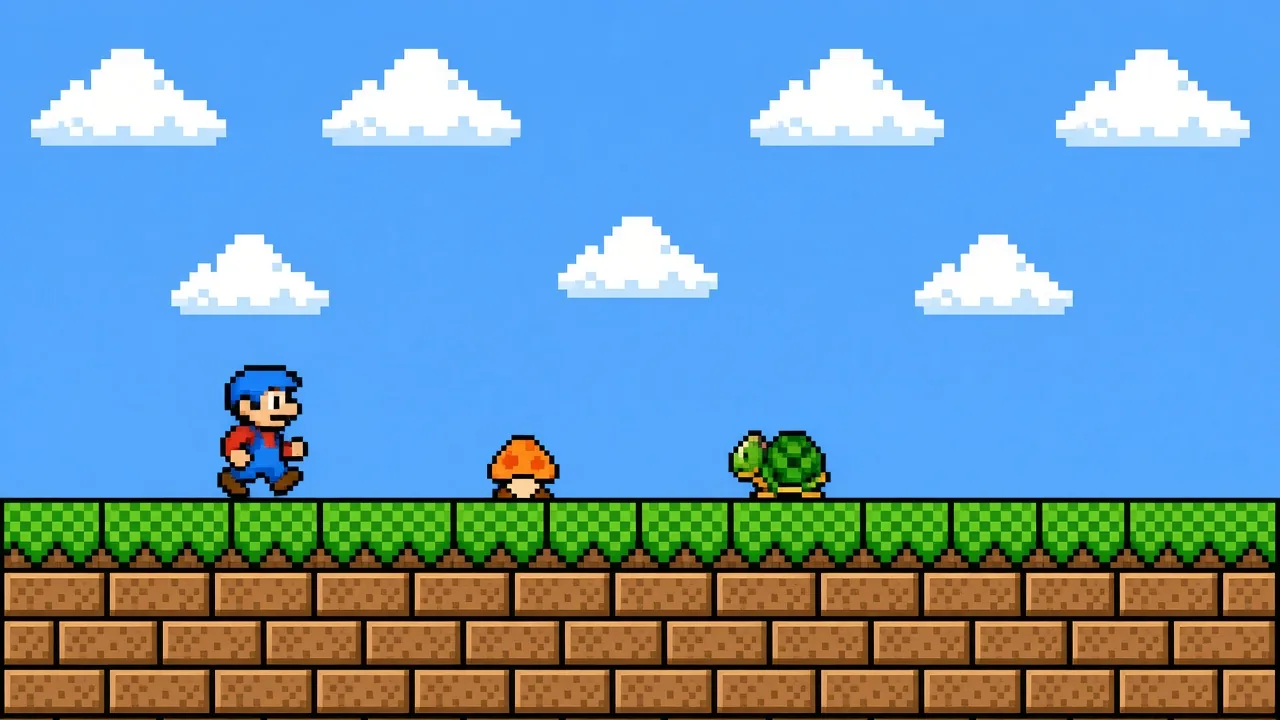
Illustration: a NES-era tilemap habit — reusable ground strips, quiet background, readable hero.
Palettes as composition, not decoration
A NES background tile region could only pull from a small shared set of colours. Sprites had their own tiny palettes. The result was not poverty of style; it was hierarchy. Important objects got contrast. Backgrounds stayed quieter. Eyes found the player without a glow effect.
When we set palettes for Tales of Xdripia and for other Arcadian work, we still ask the same questions:
- How many colours does a character need to read at native scale?
- Does the UI steal the palette from the playfield?
- If we drop to a handheld-sized screen, does the silhouette still hold?
Those are NES questions in modern clothes.
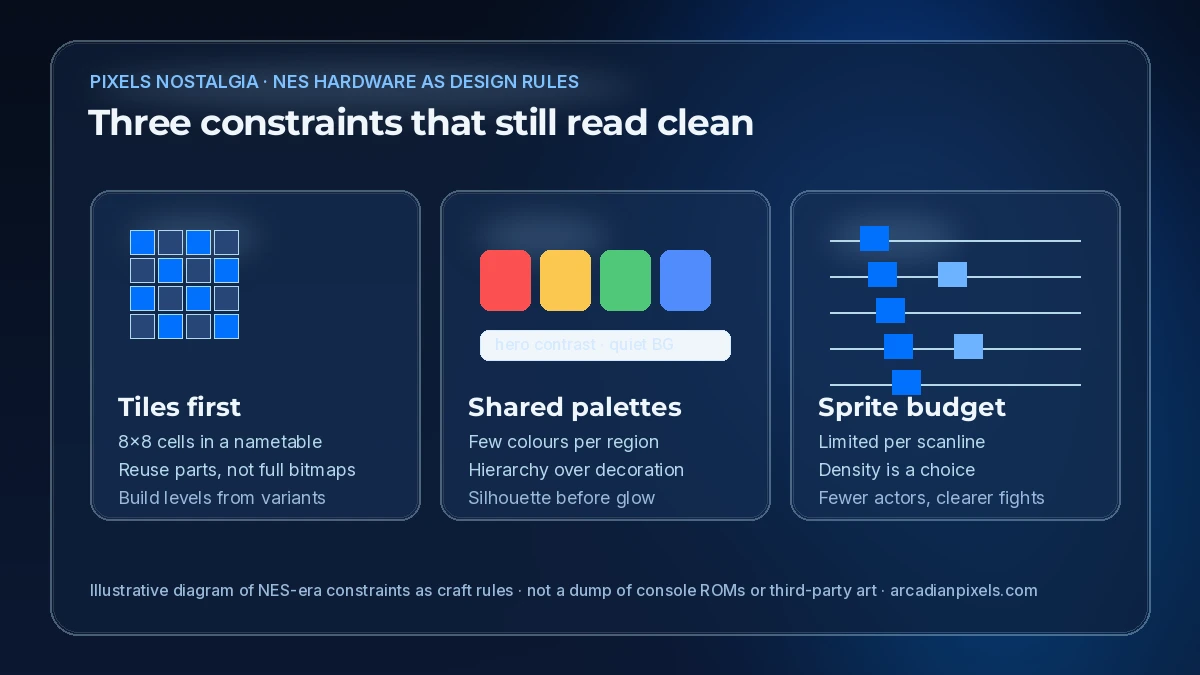
Craft note: tiles, shared palettes and sprite budgets as design choices, not only hardware limits.
Sprite limits and honest staging
Hardware capped how many sprites could sit on one scanline. Games answered with flicker, with careful staging, with enemies that entered from the edges instead of filling the frame. The lesson is not “imitate flicker”. It is that density is a design decision. A busy fight that the hardware cannot draw cleanly is a fight the player cannot read cleanly either — even on a GPU that could draw ten thousand quads.
For encounter design and VFX, we still prefer fewer, clearer actors over a crowd that collapses into noise at 320×180.
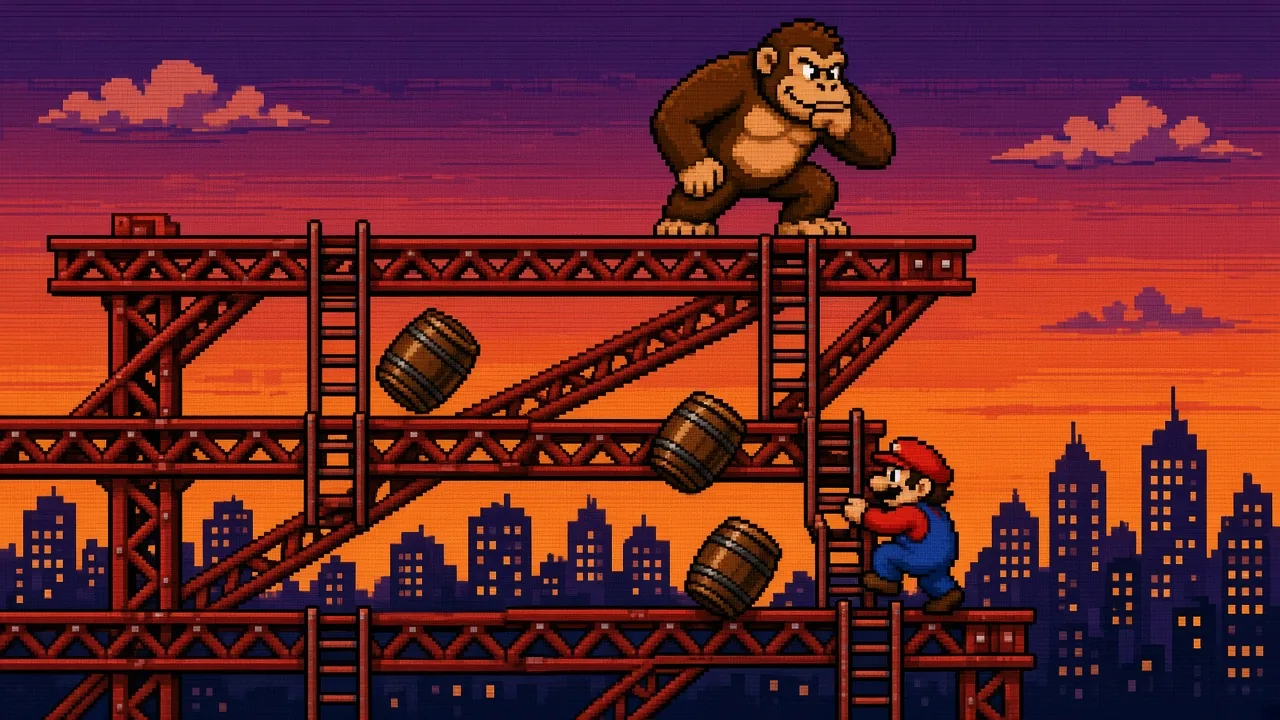
Illustration: classic arcade-to-console staging — few actors, clear path, density as a design decision.
What we will cover next
Gaming Nostalgia will move through eras with the same lens: arcade readability, Master System and Genesis colour tricks, Super Nintendo Mode 7 and layering, early 3D on PlayStation and N64, and how those choices map to tools we use now. Each piece stays short, sourced where we cite hardware or history, and tied back to practice.
Tomorrow we leave the living room and go back to the cabinet: how early arcade games taught attract-mode clarity — and why that still matters for store pages and first-minute onboarding.
Studio note
Arcadian Pixels is the gaming and coding division of XDRIP Digital Management LLC. Our main game project, Tales of Xdripia: The Seventh Amulet, keeps its Friday Developer Diary. Gaming Nostalgia sits beside that diary: history and craft for anyone building games with deliberate limits.