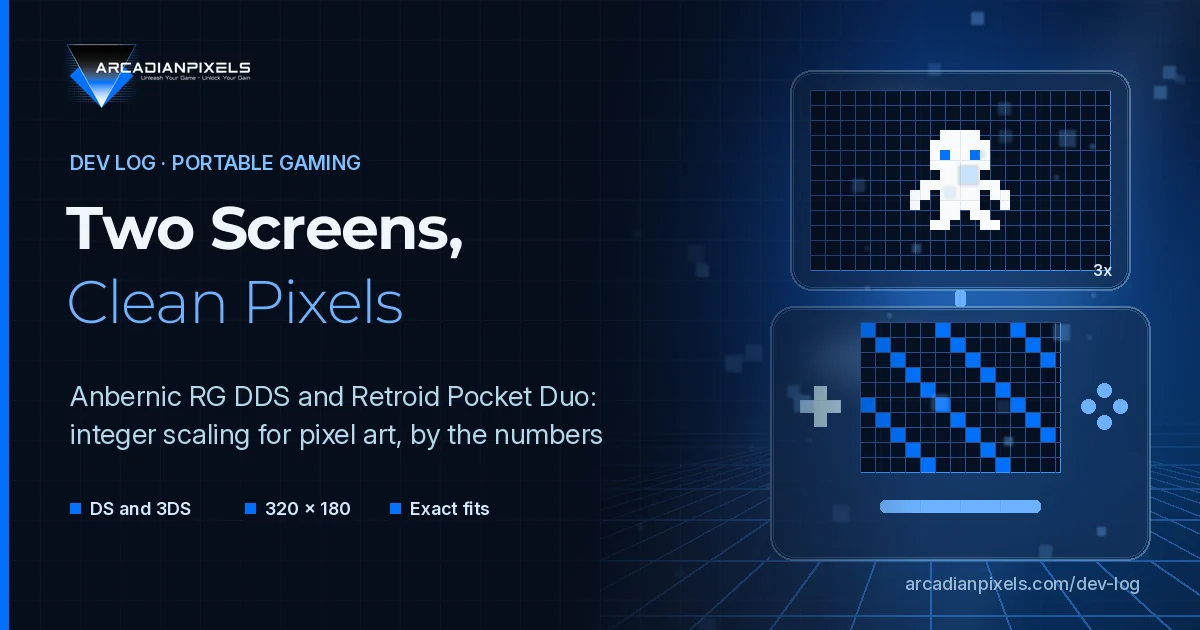
October 2026 has turned into a dual-screen month for handheld gaming. Anbernic announced the RG DDS on 9 October, Retroid started shipping its Pocket Duo on 21 October, and AYN teased a new Odin 3 Portal on 13 October. The first two devices are clamshells with two displays, built mainly around Nintendo DS and 3DS emulation, and both publish exact panel resolutions.
For players, this is a question of which device to buy. For developers who work in pixel art, it is a more practical question: how do these panels treat low-resolution images, and what does that mean for a game that might one day run on two screens? This Dev Log looks at the published specs and does the scaling arithmetic.
What was announced
Anbernic RG DDS
In its RG DDS announcement, Anbernic describes an approximately 4.7-inch upper IPS display at 1200 × 720 (5:3) and an approximately 4-inch lower IPS display at 960 × 720 (4:3). Both panels are rated at 300 PPI and 500 nits. The chip is a Qualcomm Snapdragon G2 Gen 2, with active cooling, a 6000 mAh battery, a retractable stylus and controls placed on both sides of the lower screen.
The key line for pixel work is Anbernic's own: each display "triples the width and height in pixels of the corresponding original 3DS image while preserving its aspect ratio". As The Verge reported on 14 October, Anbernic had not yet published a price or full performance details at that point.
Retroid Pocket Duo
Retroid's Pocket Duo product page lists a 5.5-inch AMOLED primary screen at 1080p and 120 Hz and a 4.5-inch AMOLED secondary screen at 960p and 120 Hz. Coverage from PC Guide gives the exact resolutions as 1920 × 1080 and 1280 × 960. The device uses a Qualcomm Dragonwing Q-7790 with an Adreno 722 GPU, 8 GB of RAM, 128 GB of storage, Android 16 and a 6000 mAh battery. The listed price is $269. According to Notebookcheck, Retroid announced on X that shipping would start on 21 October, a week later than first planned.
AYN Odin 3 Portal
AYN's Odin 3 Portal is a single-screen device with a larger display than the standard Odin 3. As Retro Sensei noted, the company has shown a teaser but no confirmed specifications, price or release date. We leave it out of the numbers below until AYN publishes them.
Why integer scaling matters
A pixel-art frame looks clean when every source pixel becomes a whole block of screen pixels: 3 × 3, 4 × 4, and so on. With a non-integer factor, some source pixels get one more row or column than their neighbours. Thin lines change thickness as they move, and dithering patterns shimmer. The usual fixes are integer scaling with borders, or scaling with filtering and accepting softer edges.
The reference resolutions are the original hardware: the Nintendo DS used two 256 × 192 screens, and the 3DS used a 400 × 240 top screen and a 320 × 240 bottom screen. Many modern pixel-art games also use 320 × 180 (16:9) or 320 × 240 (4:3) as an internal resolution.
The scaling arithmetic
The table below takes the published panel resolutions and calculates the largest whole-number scale that fits, plus whether it fills the panel exactly. These are our own calculations from the manufacturers' figures, not measurements on the devices.
| Source image | RG DDS top 1200 × 720 | RG DDS bottom 960 × 720 | Pocket Duo top 1920 × 1080 | Pocket Duo bottom 1280 × 960 |
|---|---|---|---|---|
| 3DS top, 400 × 240 | 3×, exact fit | 2× (800 × 480) | 4× (1600 × 960) | 3× (1200 × 720) |
| 3DS bottom, 320 × 240 | 3× (960 × 720) | 3×, exact fit | 4× (1280 × 960) | 4×, exact fit |
| DS, 256 × 192 | 3× (768 × 576) | 3× (768 × 576) | 5× (1280 × 960) | 5×, exact fit |
| 320 × 180 (16:9) | 3× (960 × 540) | 3× (960 × 540) | 6×, exact fit | 4× (1280 × 720) |
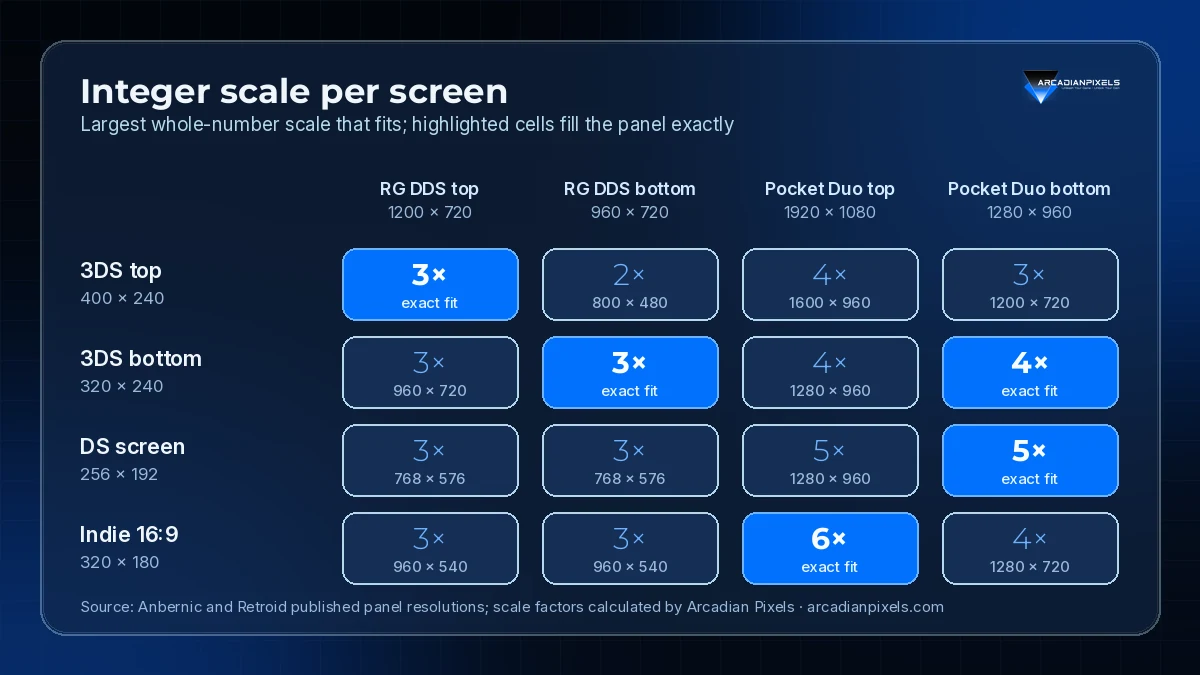
Source: Anbernic and Retroid published panel resolutions; scale factors calculated by Arcadian Pixels.
Two different design choices show up in the numbers.
- The RG DDS is built around the 3DS. Both of its screens are exact 3× multiples of the 3DS screens, so 3DS content fills each panel with no borders and no fractional pixels. DS content lands at 3× with borders, or at 3.75× if stretched to fill.
- The Pocket Duo is friendlier to the DS and to 16:9 pixel art. Its bottom panel is an exact 4× for the 3DS bottom screen and an exact 5× for a DS screen. Its top panel is an exact 6× for 320 × 180, a very common base resolution for modern indie games. The 3DS top screen lands at 4× with borders.
Neither device is "better" from this table alone. It shows which kinds of images each panel shows without compromise.
Notes for developers
Pick a base resolution with several clean multiples
If a project targets handhelds as well as desktop, check the base resolution against more than one panel early. 320 × 180 gives a clean 6× on 1920 × 1080 and on the Pocket Duo top screen, but only 3× with borders on the RG DDS top screen. 320 × 240 is exact on both bottom screens listed here. A short table like the one above, done before production starts, avoids redrawing UI later.
Treat the second screen as optional
Both devices run Android. On Android, an app sees a second panel as an additional display, and the platform provides the Presentation class for showing content on a secondary display. Whether a specific engine exposes this cleanly on these devices is something to test on real hardware. The safer design is a game that works on one screen and uses the second for maps, inventory or touch input when it is present.
Plan for touch on the lower screen
The RG DDS ships with a stylus, and both lower screens are where touch input happens on DS-style layouts. UI drawn at an integer scale on the lower panel keeps touch targets aligned with the pixel grid, which makes hit areas easier to reason about.
Do not plan around unconfirmed devices
The Odin 3 Portal has no published specs yet, and the RG DDS has no confirmed performance figures. Build tables like ours from manufacturer pages, and update them when the official numbers arrive.
What we are watching
We will follow the first hands-on reviews of the RG DDS and Pocket Duo for real-world scaling behaviour in DS and 3DS emulators, and the official Odin 3 Portal specs when AYN publishes them. For the broader handheld picture, see our earlier post on retro handhelds and pixel art lessons.