This is the Friday Developer Diary for Tales of Xdripia: The Seventh Amulet. It covers the week from 22 to 29 October 2026 and is built from the studio's weekly progress summary of 29 October. Official site: talesofxdripia.com.
Last week's diary followed a Verdalia branch through encounter rules, village layout and build fixes. This week there is no new playable slice to report. The work went into two less visible but necessary areas: art density for Verdalia and the production pipeline that carries those assets into the engine, alongside a round of updates to the public Codex.
Where the week stands
The short version:
- A first density pass for Verdalia's village and outdoor props is closed.
- Three prop packs are ready for import into Unreal Engine. Import and placement come next; they are not in a public build yet.
- A fourth pack, shelving, is in art revision.
- Shared surfaces and materials have approved references and are being crafted.
- On the Codex, 25 architectural styles received updated galleries, and the CyberHaven and NeoNexus Atlas plates were refreshed.
Production on Unreal Engine is underway, and the new art and architecture work targets Unreal Engine 5.8. This diary reports progress on that pipeline; it does not announce a release or a finished region.
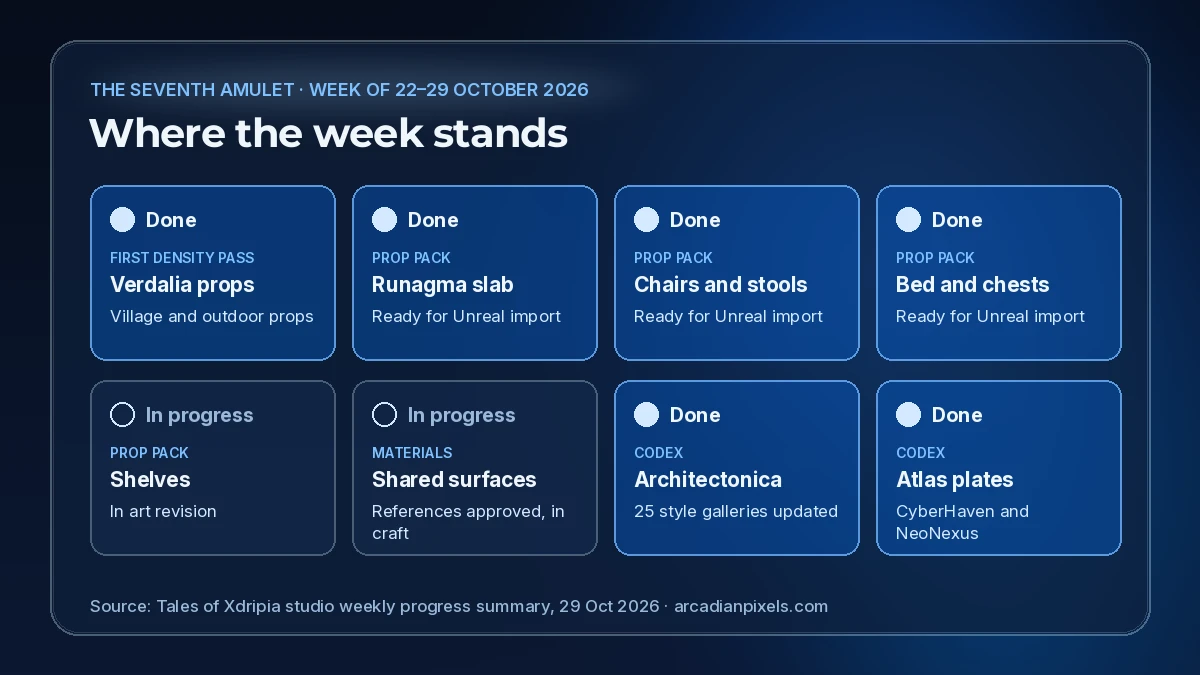
Built from the studio's weekly progress summary, 29 October 2026.
Verdalia: filling the village
A hub only feels inhabited when the small things are there. The first density pass for Verdalia focused on exactly those: the objects that sit in yards, along paths and beside doors.
The pass covered village and outdoor props such as:
- wells
- chests
- sacks
- tools
- buckets
- barrels and crates
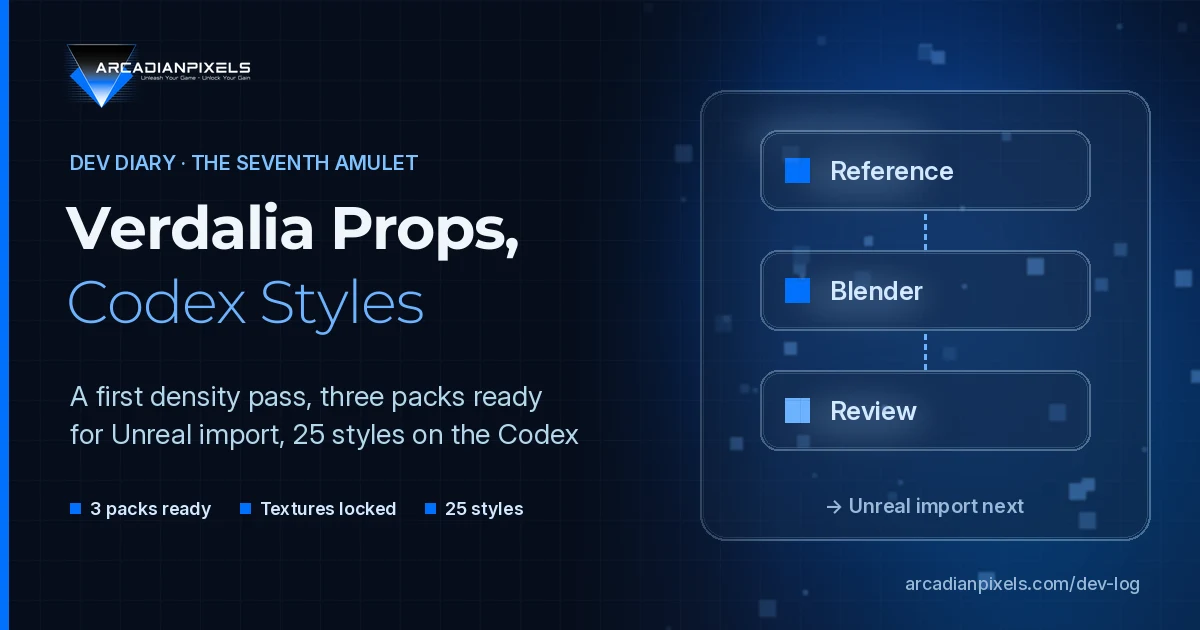
Each piece follows the same route: a reference from film and visual research sets shape and material, then the model is built in Blender against that reference.
Shared where it makes sense
Barrels and crates were promoted to reusable "Common" assets. They show up in more than one hub, so it makes little sense to model them once per region. Building them once as shared props keeps them consistent across the world and frees time for the objects that actually define Verdalia.
A rule for moss
One art direction decision was locked this week: interior furniture carries no moss. Moss belongs to outdoor surfaces and hardscape, such as walls, paving and stone, not to the chairs and beds inside people's homes.
It sounds like a small detail, but rules like this keep a region readable. Outdoors, moss tells you about weather and age. Indoors, it would suggest neglect that the story does not intend.
Three packs ready for import
Three prop packs for Verdalia are finished on the art side and ready to be brought into Unreal Engine:
| Pack | Status |
|---|---|
| Runagma slab | Ready for import |
| Chairs and stools | Ready for import |
| Bed and chests | Ready for import |
| Shelves | In art revision |
"Ready for import" means the models are done and reviewed. They still need to be imported, set up and placed in the level. Until that happens they are not part of any public build, and we will not show them in-engine before they are.
Shared surfaces and materials
Next to individual props, the studio is building shared surfaces and material instances: the reusable materials that many meshes draw on. The references for these are approved, and crafting is in progress. It follows directly after the shelving pack.
A fixed home for textures
The texture library now has a locked structure. Textures are stored by scope, either Common or Verdalia, and then by type:
- Atlas: many small elements packed into one texture.
- Trim: tileable strips used along edges, beams and borders.
- Unique: textures made for a single asset.
Naming follows Unreal Engine conventions, with Nanite conventions applied to opaque meshes. None of this is visible to players. It is the kind of housekeeping that avoids lost files, duplicate textures and broken references once hundreds of assets are moving between tools.
Codex: 25 architectural styles
The public Codex is where we document the world itself. This week the Architectonica tome received updated style galleries for 25 architectural styles. Each gallery is built around four views: a hero image, a street view, an interior and a detail.
You can browse them in Architectonica and in the architectural styles category. Two examples:
One style, Verticalism, was deliberately left as it was.
These galleries matter for the game as well as for the lore. They are the reference that architecture in each region is checked against, so updating them first keeps the buildings in the game consistent with what the Codex describes.
Atlas plates: CyberHaven and NeoNexus
In the Celestial Atlas, the location art for two places was refreshed, both now shown in a Harmonic Technomancy day look:
Behind the scenes
The studio keeps a single asset tracker current, so every prop, pack and texture has a visible status, from reference to import.
What comes next
- Import and placement of the three finished prop packs into Unreal Engine.
- Shelving through art revision.
- Shared surfaces and materials through craft.
There are no screenshots in this diary. Nothing new was captured in-engine this week that is ready to show, and we prefer to wait for real captures over showing work-in-progress out of context.
Tags
#TheSeventhAmulet #TalesOfXdripia #UnrealEngine #GameDev #DevDiary #IndieDev